Showing posts with label architecture. Show all posts

Sunday, December 01, 2013

Exhibition by I.Luse and D.Luse "Parallels of light" - 02.12.2013.-29.12.2013.

This exhibition is opened in the Cesis culture house (Cesis kulturhus).
Exhibition where can see in one place works of mother and daughter.

I.Luse - Since 1998 Lector of painting departement, Art academy of Latvia

Irena LuseIrena Luse - irenaluse.com

In the earlier periods she worked with pastel.
"By choosing pastel I am trying to discover its secrets.  I think, its refined colour range is perfectly suited for the rendering of a woman's changeable moods and diversity of feelings".

In this exhibition you will see artworks by I.Luse what are made in the 6 years period in the different technics. In this time there are  landscapes in water - colour.

Painting by D.Luse excites audience with atmosphere of antiquity, harmonic illustration of medieval abbey and cathedrals.

 Dita LuseDita Luse - ditaluse.com


Photos from the exhibition 

Saturday, February 16, 2013

The main building of the LNMA is closed for reconstruction till 2015

www.lnmm.lv

Reconstruction project by  "Processoffice" and "Andrius Skiezgelas Architecture".

Project area : 8249 m2


www.lnmm.lv

Sunday, April 22, 2012

Tornakalns - Fletcher Priest architects

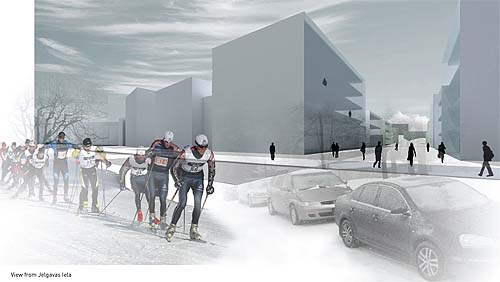
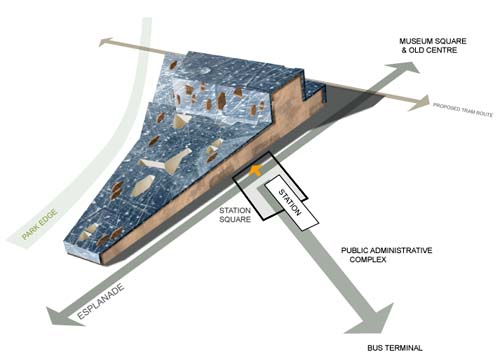
They won in tender with New Urban Centre, Riga

Tornakalns. Fletcher Priest architects


The brief of the new urban centre was that it should express both the economic growth of the young and rapidly  growing nation but still by sympathetic to its surroundings.

Museum squeare and old centre. Fletcher Priest Architects
In the Riga development projects Tornakalns is administrative, research and education centre


References: www.fletcherpriest.com


Walking tour in my suburb Tornakalns - Tile I

I wanted to start walking tour through my suburb with watching and to find out more about old wooden buildings in it. Tornakalans (Tower Hill, Thorensburg) located on the westbank of Riga.


During the Middle Ages, as well as nowadays, one could get to Riga from south and west only by crossing the River Daugava. The first bridge across the Daugava, however, was built only 1701, so throughout  the Middle Ages all traffic was carried on by boats and farries, in winter on sledges over the frozen river. The traffic across the Daugava was particularly important to those citizens who had horses and cattle, for they had meadows in the environs across the Daugava - simply called ultra Dunam, over der Dune by medieval Rigans, and hay as fodder for their animals was as important as food to the animals' owners. In medieval Pārdaugava several ecclesiastical institutions as well as some of the richest merchants had set up farms, and the cathedral chaplain had its watermill. At the left bank of the Daugavas several important transit highways also began, leading to Zemgale and Kursa and, further, to Memel (Klaipeda) and Prusia, where the Teutonic Knights had their headquarters.


At the end of 18th and at the beginning of 19th century Tornakalns was the place of the rest rich townsman, who built their farmsteds here.

Why wooden  buildings? Forests and timber materials are national values of Latvia. It accounts for a strong tradition of wooden architecture, which stands out with a diversity of styles and unusually high level in artisanship. Taking into account that Riga has always been an international seaport and Baltic metropolis, the wooden architecture mavellously combines influences of Latvian, German, Russian, Swedish and Polish artisanship. Riga's wooden houses are richly adorned.

Riga map showing wooden buildings

Tornakalns.Wooden houses

Riga's historic center houses an estimated 5000 buildings, and 10% of them are wooden heritage sites. All of Riga can boast of 3500 historical wooden buildings. This dotted map highlights Riga's wooden heritage - which may be linkened to a constellation entwined the urban fabric.


References:
Other Riga www.citariga.lv
Riga wooden architecture.Office of the Riga architect
Senā Rīga (Old Riga), Latvijas Vēstures institūta apgāds, 1998